
Neighborhood · São Paulo/SP
Chácara Flora
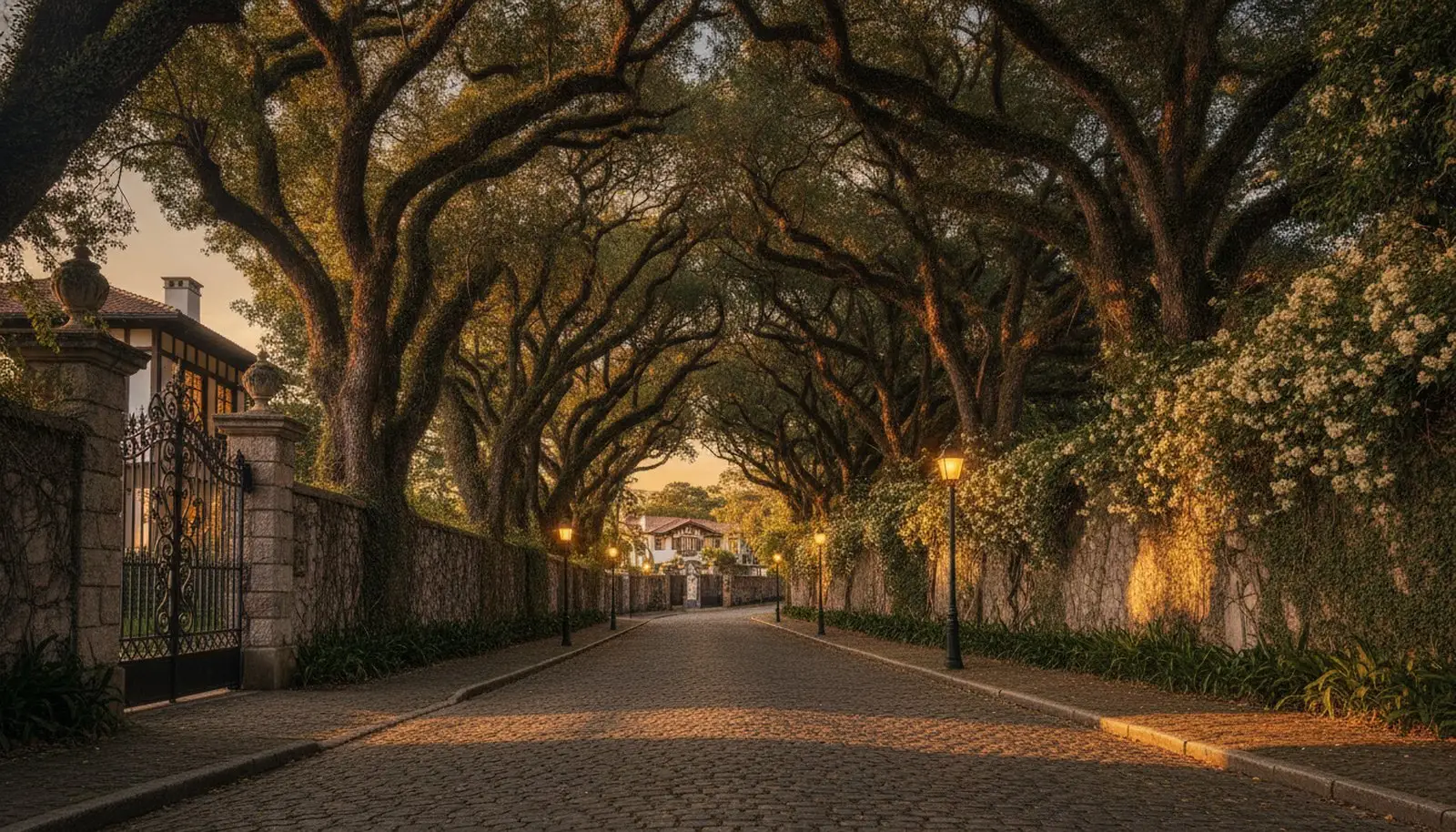
Subdivided in 1924 on garden-city principles: more than a million square metres with a remnant of Atlantic Forest, guardhouse access and streets that belong to residents — not a condominium, but a gated neighbourhood.
The neighbourhood’s story
Chácara Flora is the work of engineer Louis Romero Sanson, majority partner of S/A Derron Sanson — the same company that conceived the private toll motorway linking São Paulo to Santo Amaro, back when Santo Amaro was still an independent municipality, and which today is called Avenida Washington Luís. The subdivision dates from 1924, laid out according to Ebenezer Howard’s garden-city principles, and that is what explains the layout to this day: long blocks, plots on a country-estate scale, and roads that serve as a through-route for no one. There is a legal distinction that almost everyone gets wrong and that changes everything — from how costs are shared to the very nature of each house’s title deed: the streets and common areas belong to the residents, gathered in the Sociedade Melhoramentos Chácara Flora, set up in 1967. It is a residents’ association, not a condominium under building law. Within the perimeter a remnant of Atlantic Forest has survived, with its own fauna, and the municipal tree-cover survey records around 60% of the blocks’ area under tree canopy there — the largest continuous patch of vegetation mapped in the city. There are only a few hundred houses — the figure runs from about a hundred and seventy to two hundred and fifty — and the degree of seclusion is such that not even Google Street View has been inside: of the internal streets, the only published image is of the guardhouse.
A subdivision of more than a million square metres within the capital, with standing forest and controlled access, is a historical event, not a product. The 1924 design fixed the number of plots, and it does not increase.
Chácara Flora: a 1924 garden neighbourhood with a guardhouse at the entrance and Atlantic Forest inside. A hundred years of layout that the city has not managed to change.
The surrounding area
- Clubs: the São Paulo Golf Club, in neighbouring Santo Amaro — a course laid out there since 1915, founded in the early twentieth century by British engineers from the São Paulo Railway and redesigned by Stanley Thompson in the 1930s — and the Hípica de Santo Amaro, a few minutes away.
- Schools: Chapel School, founded in 1947 for the children of São Paulo’s American families, sits inside the neighbourhood, on Rua Vigário João de Pontes; the Chácara Flora campus of The British College of Brazil, with a British curriculum and the IB Diploma, is within the same radius; Colégio Suíço-Brasileiro and Colégio Visconde de Porto Seguro complete the picture.
- Dining and lifestyle: there is no commerce within the perimeter — and that is by design, not a shortfall. Restaurants, retail and services are found in Santo Amaro, at Market Place, at the Morumbi shopping centre and at Shopping Jardim Sul, all a few minutes away by car.
- Parks: Parque Alto da Boa Vista, on the corner of Rua Visconde de Porto Seguro and Vigário João de Pontes, practically next to the guardhouse, and Parque Severo Gomes, in Granja Julieta; inside the neighbourhood, the forest reserve and the lakes are for residents’ use.
In the Fragata archive
Chácara Flora is in the collection on the strength of its name: it is a direct neighbour of Alto da Boa Vista and appears in the surroundings of the Santo Amaro pages, and no southern-zone neighbourhood page reads in full without it. There is not yet a listed address here, and there is a reason of form: the neighbourhood is made up of single-family houses on original plots, not developments — there are no towers, blocks or developments to catalogue. Anyone looking for a house in Chácara Flora starts the conversation with an advisor, not from a listing.
In the Fragata collection
One address in this neighbourhood is in the collection, with its full entry. Our curation keeps mapping the rest.