
Neighborhood · São Paulo/SP
Granja Julieta
A name that outlived the farm that gave rise to it: for the market it is an entire residential core of the southern zone, for the Post Office it is two streets — and inside it there once stood what was said to be the largest private zoo in Latin America.
The neighbourhood’s story
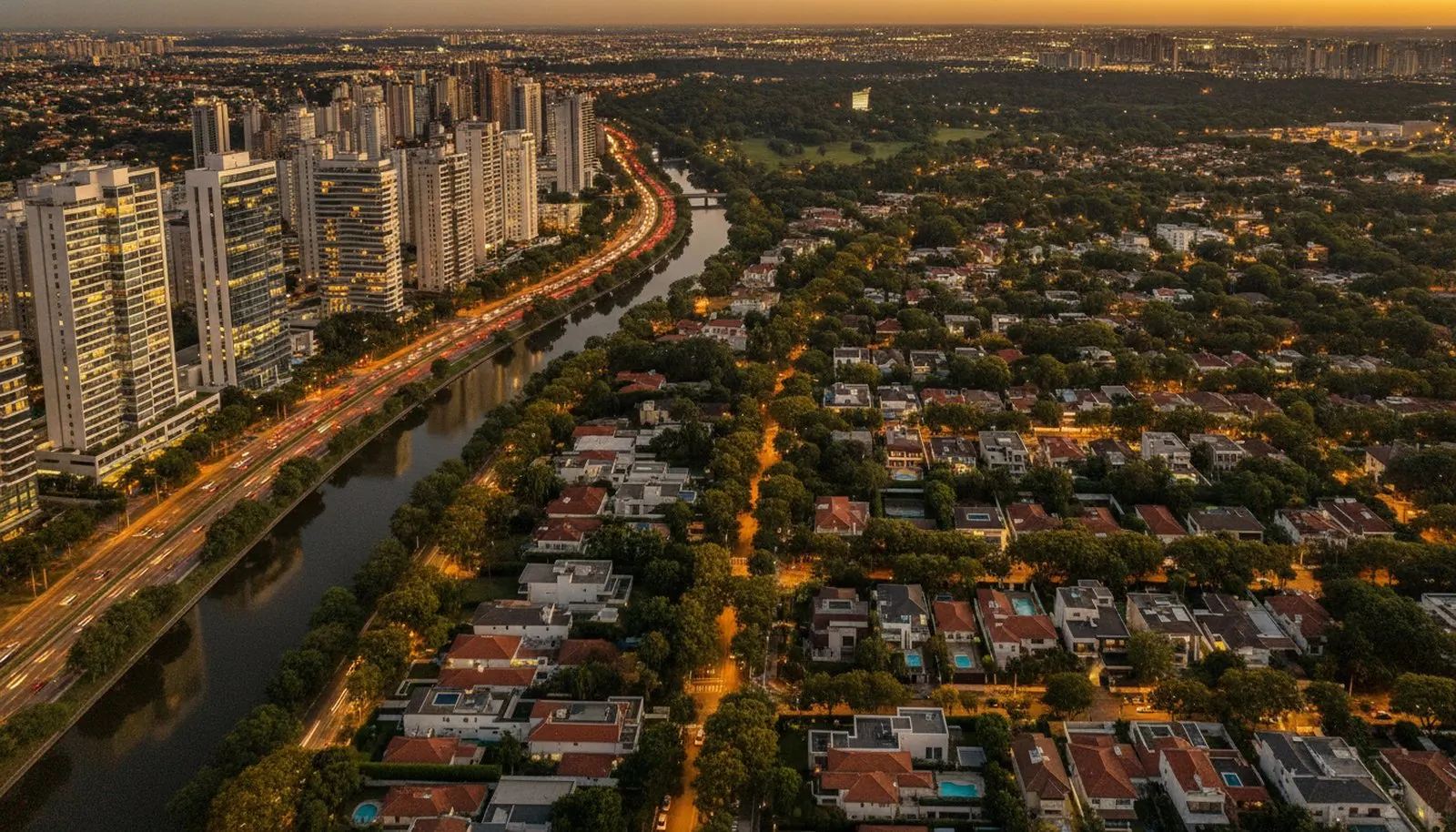
Granja Julieta is a neighbourhood in the Santo Amaro district, squeezed between the Marginal Pinheiros and the Avenida Santo Amaro and João Dias avenues. The name comes from a domestic tribute: Julieta was the wife of the Azorean Manuel Justino de Almeida, owner of the property, which was previously called Chácara dos Belgas. Next door lay Vila Elvira, belonging to the Barroso family, which ended up incorporated into the farm. It is said that the largest private zoo in Latin America once stood there, with antelopes, bears and jaguars — and the only surviving building from that period is the dovecote at Praça Bartolomeu Pimentel, from the first half of the 20th century, which was in ruins in the 1980s and was rebuilt in the 1990s. Before that, the place was already a point on the map for another reason: the “Parada do Galinheiro” [Henhouse Stop], on the old Companhia de Carris de Ferro de São Paulo a Santo Amaro, the line that linked the capital to the then village of Santo Amaro.
Residential occupation began in the 1950s and by the 1970s was practically complete, upper-middle class, under strictly residential zoning — the old Z1, which is why the core remains houses rather than towers. In 1958 the Lutheran Igreja da Paz arrived. And in 1989 the city council revitalised the Parque Granja Julieta, renamed in 1992 as Parque Severo Gomes, in honour of the senator who died in the plane crash that also killed Ulysses Guimarães: almost 35,000 m² of remaining forest over what was left of the farm and Vila Elvira.
Here the house’s usual rule appears inverted, and it is worth saying so plainly. For the Post Office, “Granja Julieta” is almost nothing: two streets — Rua Granja Julieta and Praça Bartolomeu Pimentel. The neighbouring block is already Chácara Santo Antônio, or Várzea de Baixo, or Santo Amaro. It is the market, not the postcode, that stretches the name over the entire residential core — helped by Estação Granja Julieta on Line 9-Emerald, which carries the name to an area much larger than the postal register recognises. The postcode governs the address, market usage governs the neighbourhood — and this time it is usage that is generous.
Strictly residential zoning since occupation began, in a corner of the city that has verticalised everything around it. The product is a house on an original plot, and it does not multiply: the farm was divided up once, and the corporate corridor of Avenida Santo Amaro hemmed in what remained.
Granja Julieta: a private zoo, a dovecote and two streets’ worth of postcode. The name outlived the farm and now covers an entire core that the Post Office calls something else.
The surrounding area
- Clubs: the Hípica de Santo Amaro, right next to the neighbourhood, with the green areas that form the backdrop to the residential core; and the São Paulo Golf Club, in neighbouring Santo Amaro, a course established there since 1915.
- Schools: Colégio Suíço-Brasileiro, Chapel School, Colégio Visconde de Porto Seguro and Pueri Domus, all within the same few-minute radius — one of the largest concentrations of international schools in the southern zone.
- Dining and lifestyle: Market Place and the Parque da Cidade complex, with a shopping centre, hotel and open park; Shopping Jardim Sul and the executive hotel offering that serves the neighbouring corporate corridor.
- Parks: Parque Severo Gomes, which is the farm itself preserved — almost 35,000 m² of native forest with a stream running through it, and Atlantic Forest species still standing; and Parque Alto da Boa Vista, a few minutes away.
In the Fragata archive
No address in the archive has a Granja Julieta postcode, and the reason is a matter of size: the postal neighbourhood fits into two streets. What the portfolio has is the core around it, which is what the market calls by that name. Hípica Max Garden, on Alameda Calicut, is the record that carries the Granja Julieta name in writing: postcode of Chácara Santo Antônio, Granja Julieta micro-region, right up against the green areas of Hípica de Santo Amaro and a few minutes from Parque Severo Gomes — eighteen detached houses each with their own garden and pool, on a plot that almost nobody divides up like this any more. That is the product the name carries. Anyone looking for a house in this corner of the southern zone starts the conversation with an advisor: here, a residence on an original plot rarely becomes a listing.