
Neighborhood · São Paulo/SP
Alphaville
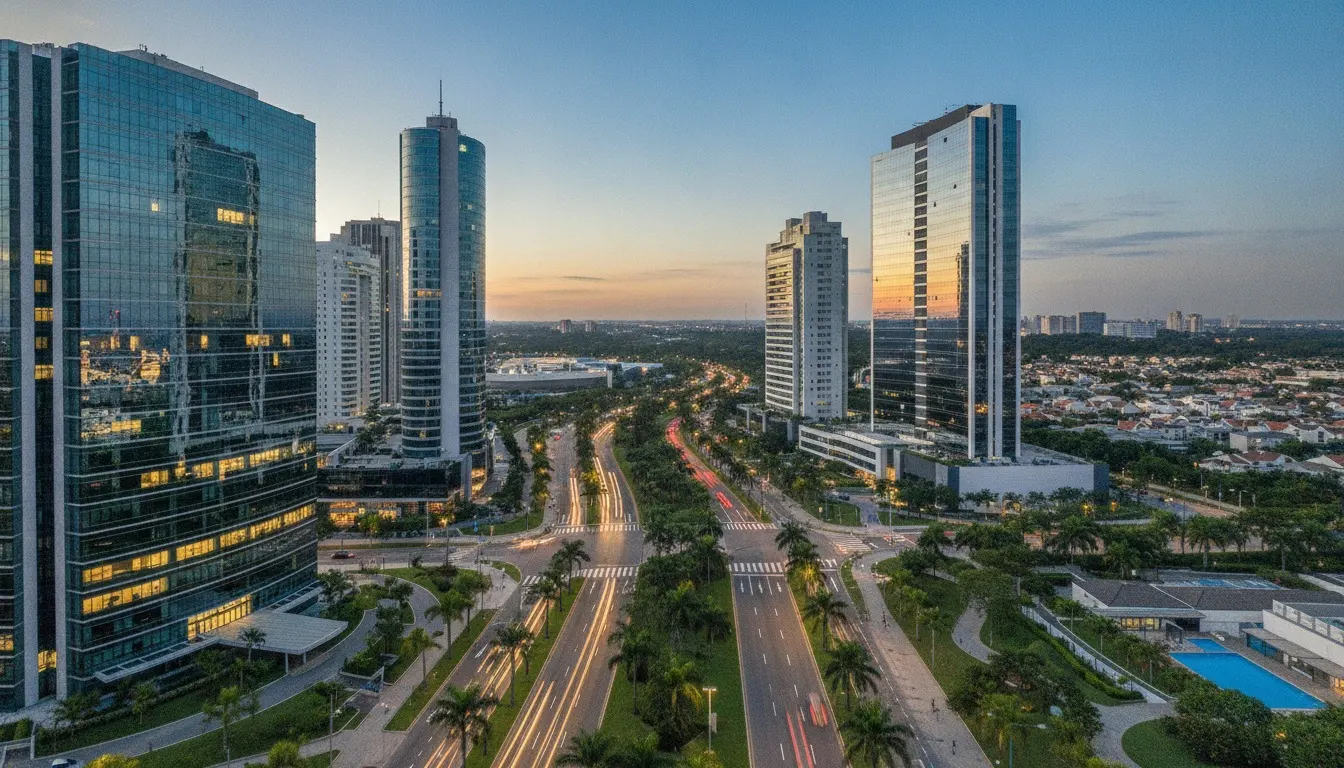
Not a São Paulo neighbourhood: it is the first large-scale neighbourhood designed from scratch in Brazil, split between Barueri and Santana de Parnaíba, made up of numbered residential developments each with its own gatehouse — and named after a Godard film.
The neighbourhood’s story
In 1973, engineers Yojiro Takaoka and Renato de Albuquerque, partners at Albuquerque Takaoka, bought five hundred hectares of the former Fazenda Tamboré from the Almeida Prado heirs. The plan was not to build homes: a housing subdivision was vetoed by the mayor of the time, so the pair instead built the country’s first industrial and business park aimed at non-polluting industries. HP was the first to believe in it, in 1975, and it was HP that suggested building houses so executives would not have to travel from the capital every day — from that came Residencial 1, the same year. It was noticed that living there paid off more than manufacturing did, and the developments began to be numbered, from zero to twelve, skipping the number seven. The rules were few and strict: no prefabricated houses, a maximum of 22 houses per block, a compulsory four-metre front setback for the garden — and it was the residents’ association, not the city council, that issued the occupancy permit. The name, difficult and borrowed from a Jean-Luc Godard film, was an obstacle before it became a brand. Today there are more than 12,000 residences, an estimated permanent population of 35,000 people and a floating population of 200,000 a day, with five 24-hour hospitals — among them the Alphaville unit of the Einstein hospital, opened in 1999 —, agencies, hotels and supermarkets within the perimeter itself. In the 1990s, Alphaville and Tamboré district tried to break away and form a single municipality; the process was shelved.
The numbered residential developments were closed off back in the 20th century — the last one launched was number 12. No new Alphaville opens: what changes hands is a plot within a perimeter that has already been entirely divided up.
Alphaville: the city that an engineering firm designed whole, wall by wall. House, school and office within the same perimeter.
The surrounding area
- Clubs: the Alphaville Tênis Clube, from 1976, is the neighbourhood’s historic meeting point; each residential development keeps its own set of courts, pitch, track and clubhouse within its walls, some with a golf training centre.
- Schools: the largest concentration of international schools in Greater São Paulo — St. Nicholas School, with a 64,000 m² campus and all three IB programmes; the Escola Internacional de Alphaville, the only one in the region with the full IB Continuum; Escola Castanheiras, with the IB Diploma; plus Pentágono, Anglo Leonardo da Vinci and Colégio Objetivo. In higher education, the Alphaville campuses of Mackenzie and UNIP.
- Dining and lifestyle: Iguatemi Alphaville, opened in 2011 with more than two hundred shops and a cinema, and Shopping Tamboré next door; the commercial and business centre that grew up around the residential developments and concentrates restaurants, hotels and services for the 200,000 people passing through daily.
- Parks: here greenery is private before it is public — preserved forest areas within the residential developments themselves, such as the Mata Voturussu in Residencial 10, and landscaped strips along the perimeters.
In the Fragata archive
There are 2 developments from the portfolio in the neighbourhood (the backlinks panel lists them all): Alphaville Residencial 1 and Alphaville Residencial 10.