
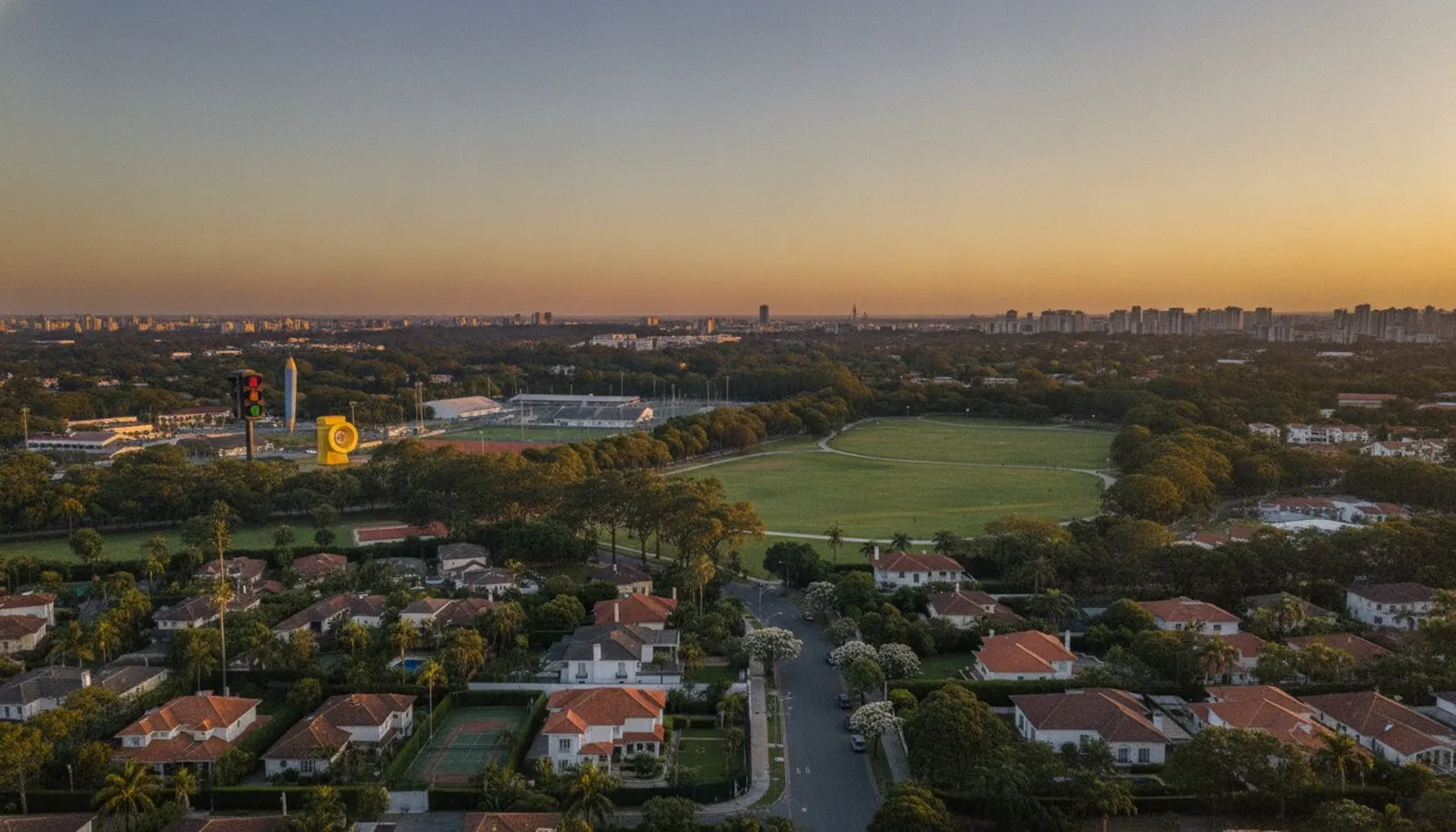
Neighborhood · São Paulo/SP
Itu
Not a neighbourhood: it is the historic town a hundred kilometres from the capital where the gated country estate was invented in Brazil — and where it remains denser than anywhere else in the country.
The neighbourhood’s story
Itu is a town in the São Paulo countryside on the Rodovia Castello Branco axis, a little over a hundred kilometres west of São Paulo. The town is old and has a place in national history: it was there that the convention which gave rise to the Partido Republicano Paulista met in 1873, and it is from Itu that the national fame of the giant replicas comes — the payphone, the traffic light, the pencil — which the townspeople have turned, with humour, into a tourist identity. Sugar built the region in the 19th century and gave its name to the road that still crosses it today, the Rodovia Waldomiro Corrêa de Camargo, the Sugar Highway; the older route, the Rodovia Marechal Rondon, still serves the northern side of the municipality.
What matters to this archive, however, began in the 1970s. It was in Itu that Senpar, then a road-building company, bought 4.2 million square metres from the nuns of Patrocínio and built Terras de São José I — the estate the group itself claims as the first gated development in Brazil, with a golf course, equestrian centre, tennis and football within a single perimeter. Almost at the same time, in 1976, Fazenda Vila Real de Itu was born on the other side of the municipality, on an 18th-century estate. The formula — wall, guardhouse, club and large plot an hour from the metropolis — spread across the whole country from here, and thirty years later Senpar itself returned to build the second generation, Terras de São José II, with five million square metres adjoining the town.
Geography explains the staying power. Itu is less than an hour from the office in the capital, twenty minutes from Sorocaba, twenty-five from Viracopos and forty from Campinas, with one of the mildest climates in the state. It is this crossing of motorways and airports, more than the scenery, that made the municipality the birthplace and, still today, the largest concentration of ultra-high-end country estates in Brazil. The perimeters of the founding estates have been closed for decades: no new residential development opens in this stretch, and what changes hands is a plot within a layout that has already been entirely divided up.
Itu: the town where the gated country estate was born in Brazil. Golf, riding and large plots less than an hour from São Paulo, in a layout that no longer expands.
The surrounding area
- Clubs: Terras de São José Golfe Clube, from 1977, is the oldest and most recognised — eighteen holes over 650,000 m², twice voted one of Brazil’s ten best courses by Golf Digest, and a national pioneer in accepting non-members. Besides it, the equestrian centres and social clubhouses of the estates themselves, with clay courts, pitches, jogging tracks and a chapel within the walls.
- Schools: the town has its own network of private schools, and there is a school attached to the Terras de São José perimeter; for the second-home public, the school of reference remains in the capital or in Sorocaba.
- Dining and lifestyle: Itu’s historic centre, with its old houses and main square, concentrates the town’s life; inside the estates, restaurants, delicatessens and clubhouses make up daily life. Sizeable hotel offering in the region, including a resort with a convention centre operated by the Terras de São José group.
- Parks: the greenery is internal — reserves, lakes, trails and woods within the perimeters themselves, with high percentages of preserved common area.
In the Fragata archive
There are 3 developments from the portfolio in the neighbourhood (the backlinks panel lists them all): Fazenda Vila Real de Itu, Terras de São José I and Terras de São José II.